3 private positions, held through vehicles whose terms bar naming the company — recused
Commitment
sha256 fc5792fdae164aadbd7280cacf15d828808eb91fe2b593f426bcc1ec2025a593 · positions record version 2026-10-09
Holdings       I hold no position in any company named in this issue, other than through broad index funds.
Intent, 90d    I hold none of the companies named in this issue or their parent companies, and I have no intention of taking a position in any of them before Feb 10, 2027.
How positions are declared, why some are not named, what a recusal means, and how the sealed record works: disclosure. Where a position I may not name sits in a company this issue would otherwise forecast, I publish no forecast on it and say so.
Reckoning covers space, defense, energy and manufacturing; this issue is the heavy end of manufacturing, where the grid and the shipyards meet.
The call
2026-11-044 · Energy
Flux Steel Works ships commercial grain-oriented steel from Ohio by end-2029
15% · Monte CarloResolves 2029-12-31
I hold no position in any company named in this issue, other than through broad index funds.
Claim, falsifier, and reasoning
ClaimFlux Steel Works, or a successor operating its Louisville, Ohio plant, publicly reports a first commercial shipment of grain-oriented electrical steel made at that plant and sold to a customer by December 31, 2029.
FalsifierNo such public report by December 31, 2029. Does NOT count: samples, trial coils or qualification coils; GOES whose grain orientation was developed elsewhere and that was only slit, cut, coated or resold at Louisville (GOES cold-rolled, decarburized and high-temperature annealed at Louisville from purchased hot band counts); an announcement of orders, reservations or offtake without a shipment.
Monte Carlo · inputsTwo levels: an outer loop of 4,000 input sets, an inner loop of 4,000 schedules each. Financing in place in time about 60%, else 12 to 36 months' delay; Flux's 2029 target at an unstated month; about 20% chance of no schedule slip, median slip 4 to 15 months; 50/50 on whether "2029" means first coils (then customer qualification of 2 to 12 months) or commercial sales. Model: scripts/forecasts/flux_mc.py.
How I got 15%
ModelTwo levels. Outer loop: 4,000 draws of the inputs. Inner loop: 4,000 schedules per draw. Month of first commercial shipment = Flux's 2029 target (month unstated) + schedule slip + customer qualification + financing delay. P(YES) = share of schedules shipping by 31 Dec 2029, averaged over the input draws.
Financing in place in time (beta 6,4, mean 0.60); otherwise a delay of 12 to 36 months = 0.60Flux has its money in place in time about 60% of the time; when it does not, the plant slips one to three years.Evidence. The release and the company site disclose no capital cost, lender or close. The range is an assumption.
Flux's target: uniform over 2029 = 2029.00Flux's own date is some month in 2029.Evidence. The 15 Sep 2026 release says commercial production is planned for 2029 and gives no first-coil date.
No schedule slip (beta 2,8, mean 0.20); median slip 4 to 15 months (lognormal, sigma 0.8) = 0.20About one plan in five runs on time; the rest slip by a median of four to fifteen months.Evidence. Assumption.
What "2029" means: 50/50, first coils or commercial sales = 0.50Even odds that Flux's 2029 means first coils off the line rather than commercial sales.Evidence. The 15 Sep 2026 release says commercial production is planned for 2029 and gives no first-coil date. Unresolved in the public record.
Customer qualification: triangular 2/5/12 months after first coils; 0/0.5/2 if 2029 means sales = 5.00If 2029 means first coils, customers take two to twelve months, most likely five, to qualify the steel.Evidence. Assumption; the weakest input.
ResultP(ship by 31 Dec 2029): mean 0.165 (median 0.138; P10 0.050, P90 0.324). By end-2030 0.461, end-2031 0.669, end-2032 0.850; median first commercial shipment March 2031. Logged at 0.17; displays as 15%.
CorrelationWithin a draw the steps are independent. One cause that slows several at once, a financing delay that also pushes equipment orders back, say, would fatten the late tail beyond what the model shows.
SensitivityWhat "2029" means drives most of it: first coils 9% (P10-P90 4-15%), commercial sales 24% (12-37%). Across the input draws, the 10th to 90th percentile is 5% to 32%.
Signals to watch
Up
A financing close with a named lender or grant.
Flux saying 2029 means commercial sales.
Equipment orders placed and installation starting by mid-2027.
Down
No financing news by mid-2027.
Flux saying 2029 means first coils.
No installation under way by mid-2027.
Not counted as evidenceFlux's reservations of over 150,000 tons: a reservation is not an order, and no customer is named.
The register holds one dated call. The model behind it gives a curve, and I publish the whole curve so the call can be read against it:
Shipped by
End-2029
End-2030
End-2031
Median date
Model
17%
46%
67%
March 2031
The entry chip shows 15% under the register’s display rule (to the nearest 5% at 10% and above); the forecast is recorded and graded at 17%.
Flux's own date is 2029. My model's median is March 2031. The gap is the argument of this issue: the steel can be built here again, and every step in front of it is slower than an announcement suggests.
What it decides: if you buy power transformers, or plan around their lead times, the second domestic source of their core steel is unlikely to be selling before 2030. Plan the next three years on one US mill and imports.
Who this changes a decision for
Utilities and grid builders. On the latest survey a power transformer took about two and a half years to arrive, and its core steel comes from Butler or from abroad. A second US mill selling before 2030 is the optimistic case. Procurement plans that assume one belong in the scenario column, not the base case.
Transformer and component makers in Mexico and Canada. Commerce found that more than 95% of US imports of transformer cores in 2019 came from Canada and Mexico. Cores made in the region are how US buyers have worked around a single domestic mill. A Louisville mill selling before 2030 would change that, and the model says it probably will not.
Port and shipyard planners. The cranes and the forgings run on the same clock: announced capacity is years from delivered capacity, and the record so far shows plans, not deliveries.
1. The list
Four heavy goods sit at the front of the queue for anyone building power, ports or ships in the United States. Each has a lead time measured in years and a domestic supply base you can count on one hand.
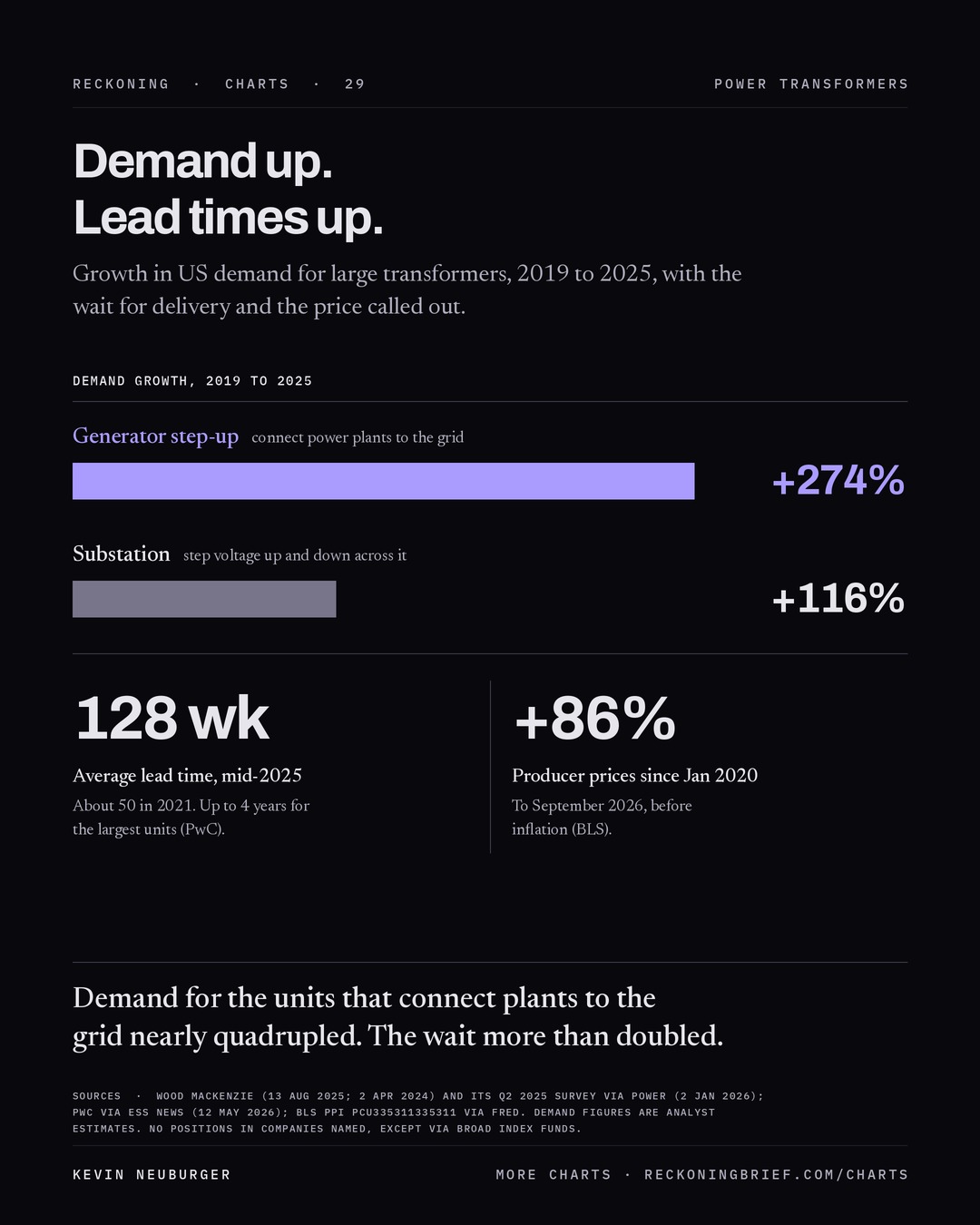
Power transformers, and the steel in their cores. In 2019, 82% of the large power transformers used in the United States were imported, according to the Department of Energy's 2022 supply-chain review; six US companies made them in 2020. Wood Mackenzie estimates that from 2019 to 2025 demand rose 274% for generator step-up transformers, the units that connect power plants to the grid, and 116% for substation transformers. Its surveys put the average wait at about 50 weeks in 2021, 120 weeks in 2024 and, for power transformers, 128 weeks in mid-2025, about two and a half years. PwC analysts put the wait for high-capacity units at up to four years. Producer prices for transformers rose 86% from January 2020 to September 2026 on the Bureau of Labor Statistics' index; the Congressional Research Service, on a different series, puts the rise at about 40% after inflation from 2020 to 2024. Smaller units have eased: Wood Mackenzie had distribution transformers back to 30 weeks by mid-2025, and 25% to 30% of them are imported. New domestic capacity is coming: Siemens Energy announced a $149.8M large-transformer plant in Charlotte, North Carolina in February 2024, with production targeted for early 2026. I found no report of its first unit. The steel inside the core is section 2.
Heavy castings and forgings. Two 50,000-ton forging presses at the center of the country's heavy forging base were paid for by the Air Force and switched on in 1955. Section 3 covers them. The Defense Department made castings and forgings a department-wide industrial-base priority in 2021, according to GAO, after its annual industrial-capabilities reports had flagged the shipbuilding supply base as a fragile market three years running.
Ship-to-shore cranes. One Chinese company, ZPMC, makes nearly 80% of the ship-to-shore cranes used at US ports, according to a September 2024 House staff report, which also found no US manufacturing alternative. Globally, the Congressional Research Service puts China's share above 70%. A 25% US tariff on Chinese ship-to-shore cranes took effect in September 2024. Two plans have been announced since. Paceco, a Mitsui E&S subsidiary, said in April 2024 it would bring final assembly of port cranes back to California for the first time since 1989. Konecranes said in July 2024 it could now build a full range of port cranes, including ship-to-shore cranes, through US partner fabricators. Neither has reported delivering a US-built ship-to-shore crane. Paceco's latest US order, two cranes for Long Beach, is being built in Japan. When the Philadelphia port authority went to bid this year, four potential bidders said they could not meet its specification, schedule or budget, and it is seeking a waiver from the Buy America rule.
Large gas turbines. Mitsubishi, GE Vernova and Siemens Energy are booked for years. Mitsubishi Power's Asia-Pacific chief said on October 27 that a new order now delivers around 2031, with 2028 and 2029 slots almost fully booked. GE Vernova reported 122 GW of gas-power backlog and slot reservations at the end of its third quarter, up from 116 GW a quarter earlier, and its chief executive put lead times on new heavy-duty orders at about three years in April. Siemens Energy's finance chief said "three years or more" in August. GE Vernova builds its heavy-duty turbines in Greenville, South Carolina, as it has since 1968. The domestic base exists; the constraint is slots.
Chart 29 shows the first of these: demand up, lead times up.
2. The steel inside the grid
A transformer's core is stacked from grain-oriented electrical steel, GOES: thin silicon steel rolled and annealed so its crystals line up with the magnetic field. The grade sets how much energy the transformer loses for as long as it runs.
It is about 20% of a transformer's cost, and its price doubled from 2020 to 2024, according to the Breakthrough Institute.
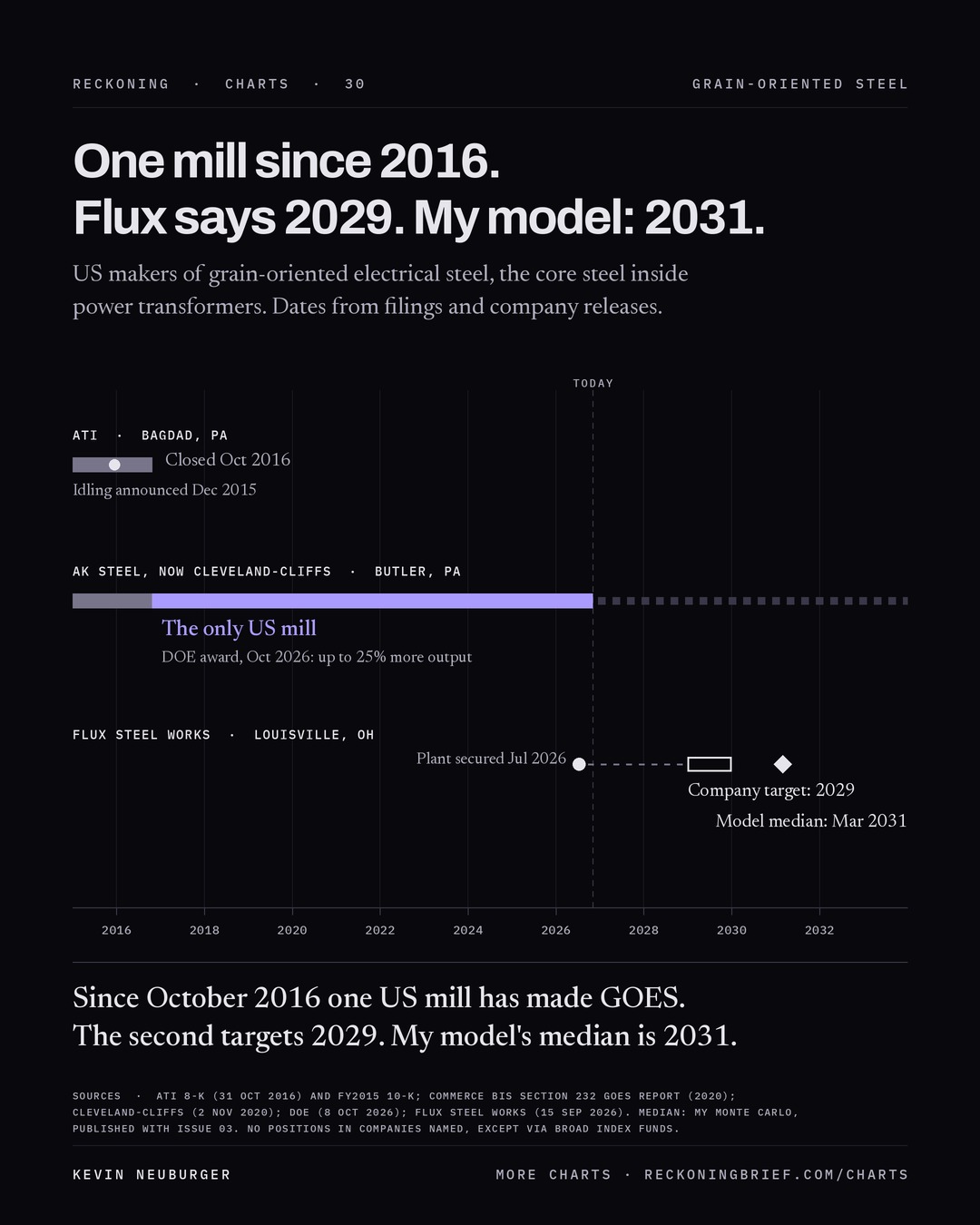
One mill in the United States makes it. ATI announced the idling of its GOES production in December 2015 and permanently closed its GOES finishing plant in Bagdad, Pennsylvania in October 2016. Since then the only domestic producer has been AK Steel's Butler Works in Pennsylvania, now part of Cleveland-Cliffs. The Commerce Department's 2020 Section 232 investigation named it the sole US producer. Domestic core makers get 95% of their steel from that one supplier, the Congressional Research Service reports. Breakthrough puts the cost of retrofitting Butler, or of building a modern GOES mill from scratch, at $1–2B either way.
How much Butler makes is not public. The best primary figure is Cleveland-Cliffs' own, from November 2020: AK Steel could make up to 250,000 net tons a year of electrical steel, across Butler and Zanesville, Ohio, and across grain-oriented and non-oriented grades combined. Commerce redacted the capacity figures in its report. In October the Department of Energy announced a $75M award toward a $200M project at Butler to raise output by up to 25%, without a tonnage.
Imports fill the gap, and they increasingly arrive already made into cores. The Breakthrough Institute reports that US imports of transformer cores went from $126M in 2018 to $524M in 2025, about 4×. Breakthrough does not cite its trade codes, and I could not reach the primary data to check it: the Census trade API now requires a key and the trade commission's DataWeb a login. The Commerce report's own series, for stacked and wound cores, runs from $22M in 2015 to $167M in 2019.
Into this steps Flux Steel Works. In September it announced it had secured a former ATI stainless finishing plant in Louisville, Ohio, 626,000 square feet, to make GOES. Its numbers:
Flux Steel Works, as announced
Capacity at full production
more than 260,000 tons a year (short or metric not stated)
First phase
about half of capacity
Commercial production
planned for 2029
Reservations
over 150,000 tons, no customer named
Capital cost
not disclosed
Financing
not disclosed; no close announced
Jobs
more than 200
The plant has not made GOES before. ATI finished its GOES at Bagdad; Louisville was a stainless finishing site, and it left ATI's filings after 2022. Flux is re-equipping a building, not restarting a line. Every figure in the table is a company claim, and the release names no customer, no lender and no capital cost.
Chart 30 puts the dates on one line: one mill since 2016, Flux's 2029 target, and the median of my model, March 2031.
3. The presses
Forged parts for aircraft and ships come off presses, and two of the biggest presses in the country are older than the Interstate highway system.
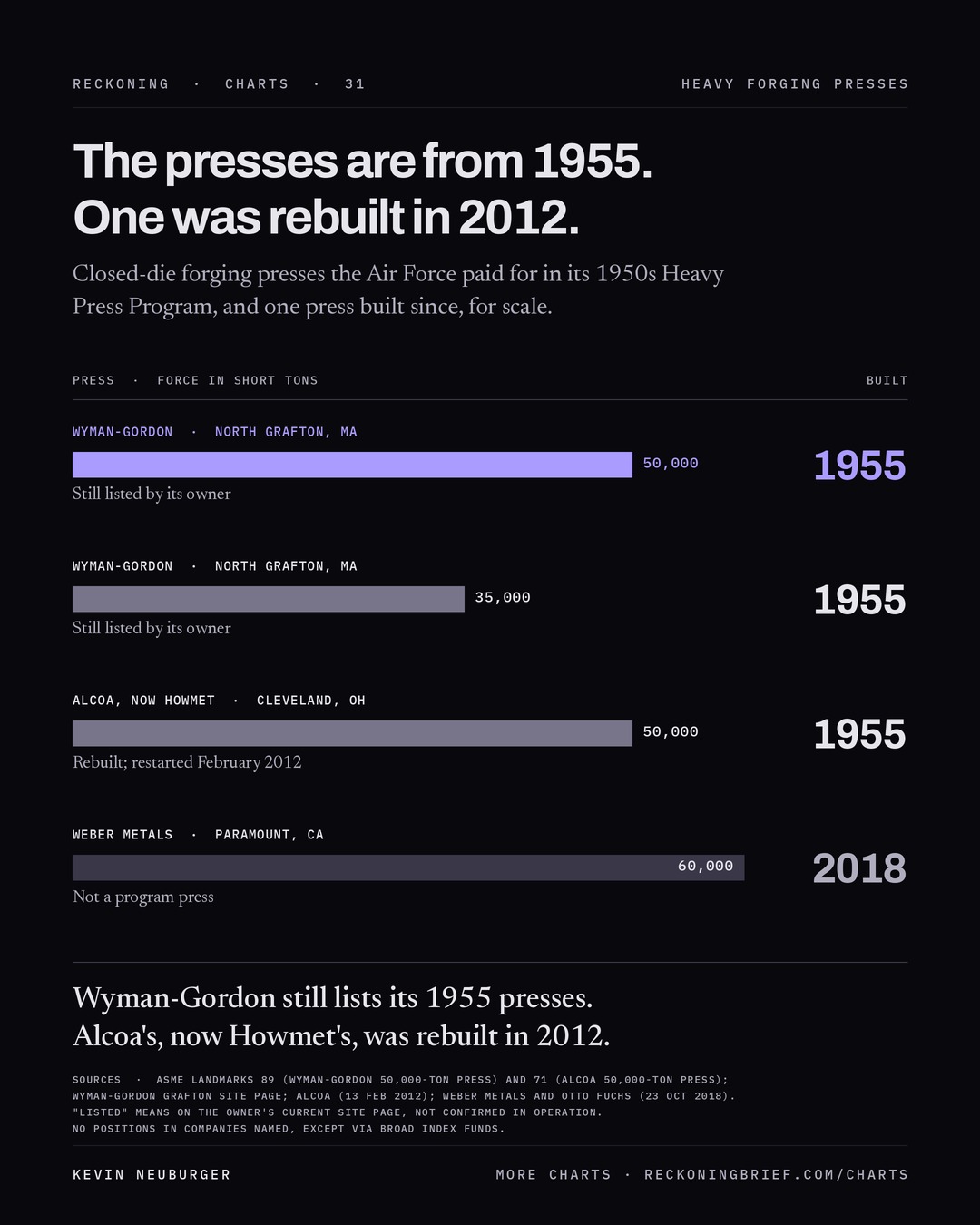
The Air Force's Heavy Press Program, in the 1950s, paid for the two 50,000-ton presses. Wyman-Gordon's 50,000-ton closed-die press in North Grafton, Massachusetts began forging in October 1955; its 35,000-ton press there began in February 1955. Wyman-Gordon bought the plant and its presses from the government in 1982, and it still lists both on its site page today. Alcoa's 50,000-ton press in Cleveland, now Howmet's, was built in 1955 and rebuilt at a cost of $100M; Alcoa announced its restart in February 2012.
A listing is not an operating record, and I am not claiming these presses run today. What the record shows is their age: the two 50,000-ton presses date from 1955. The one large press built since that I could document is Weber Metals' 60,000-ton press in Paramount, California, unveiled in October 2018 at a cost its owner put at $180M. Weber is a division of Otto Fuchs of Germany.
The Defense Department has said as much in its own terms. GAO's 2022 review of the shipbuilding industrial base found that the department's industrial-capabilities reports for fiscal 2018 through 2020 consistently flagged a "fragile market" risk: structurally poor industry economics, potentially approaching domestic extinction. Seapower reported in January 2022 that the executive director of the Navy's strategic submarine program office counted castings and forgings among "fragile market sectors," in the magazine's words. The Navy put $5.5M into preserving casting capability at one key shipbuilding supplier in fiscal 2018.
Chart 31 shows the presses, and the dates beside them.
4. The call
The question is when Flux sells its first coil of GOES made in Louisville, not whether GOES can be made in America again. The model works at two levels. I am unsure of the inputs themselves, so an outer loop draws 4,000 sets of them; for each set, an inner loop draws 4,000 schedules.
Input
In the model
Basis
Financing in place in time
about 60%; otherwise 12 to 36 months' delay
Assumed: no capital cost, lender or close disclosed
Flux's target
some month in 2029
Flux's release: commercial production planned for 2029
No schedule slip
about 20%
Assumed
Median slip, when it slips
4 to 15 months
Assumed
What "2029" means
50/50: first coils, or commercial sales
The release gives no first-coil date
Customer qualification
2 to 12 months if 2029 means first coils; under 2 if it means sales
Assumed; the weakest input
The result is 17%, the mean across the 4,000 input sets. The median is 14%, and the 10th to 90th percentile range is 5% to 32%.
One input drives most of it: what Flux means by 2029. If it means first coils, with qualification still to come, the model gives 9%. If it means commercial sales, it gives 24%.
The first version of this model, built from base rates for new electrical-steel lines, gave 8%. I moved to 17% because this one weighs the chance that Flux's 2029 means commercial production, not first coils. The older model stays in the repository, marked superseded.
What would move the number:
Up: a financing close with a named lender or grant; Flux saying 2029 means commercial sales; equipment orders placed and installation starting by mid-2027.
Down: no financing news by mid-2027; Flux saying 2029 means first coils; no installation under way by mid-2027.
Not counted as evidence: Flux's reservations. A reservation is not an order, and no customer is named.
Every figure above traces to a line in the sources page, with the date I opened it.
Correction, 12 November 2026: the summary under this issue's title first said 8% by 2029 and a median in 2032. Those were the superseded first model's figures. It now gives the model of record: 17%, median 2031. The text above, the register entry and the emails were correct.
Each issue in your inbox the morning it publishes, a note the day a forecast is graded, and occasional Reckoning news. Free, in English and Spanish. No list sharing, unsubscribe in one click. Privacy.